Published November 1, 2001 12:00AM
Sweet Relief
Luxe locales to soothe your pain
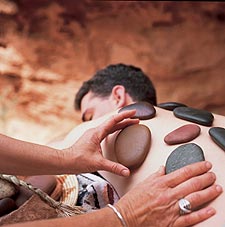
Stoned at Red Mountain (Photo: courtesy of Red Mountain Lodge)
Bearskin Lodge
GRAND MARAIS, MINNESOTA
Winters mean cross-country skiing in the expansive Boundary Waters Wilderness, and summers mean hauling yourself across the same region by canoe. Sore legs or sore arms—either way, a professional massage awaits. Lowdown: rooms, $103 to $348; 800-338-4170, www.bearskin.com. Rubdown: $60 per hour.
The Spa at Chateau Whistler
WHISTLER, BRITISH COLUMBIA
At this full-service luxury spa in North America’s hard-core skiing mecca, rub shoulders with cricket players and aristocrats who nip into the forest for a bracing round of falconry. Enjoy luxuries ranging from a Papaya Enzyme Bath to a deluxe massage. Lowdown: rooms, $180-$1,000; 800-401-4018, www.spaatchateauwhistler.com. Rubdown: $85 per hour.
Lodge at Moosehead Lake
GREENVILLE, MAINE
Cross-country skiing and snowshoeing are popular winter pastimes at this restored 84-year-old hunting lodge, but the true passion here is snowmobiling. Ach, another buttocks rub, please! In summer, after canoeing Moosehead Lake or rafting the Penobscot River, the massages are less cheeky, but still necessary. Lowdown: rooms, $145 to $425; 207-695-4400, www.lodgeat mooseheadlake.com. Rubdown: $75 per hour.
Red Mountain
IVINS, UTAH
Situated between the North Rim of the Grand Canyon and Bryce and Zion National Parks, Red Mountain bills itself as “the” adventure spa. But of course. Enjoy hundreds of miles of park trails by day; soak up seaweed wraps and hot-stone massages by night. Lowdown: rooms, $500 and up for four days; 800-407-3002, www.redmountainspa.com. Rubdown: $65 per hour.
Reset Your Inner Clock
New insights on the link between exercise and rest
BEFORE YOU retreat pathetically into your annual winter hibernation, we have some words of caution: It won’t be long until you’re losing sleep over your lazy new lifestyle. Early results in a $2 million research project by University of California-San Diego sleep guru Shawn Youngstedt show that one hour of daily moderate exercise can have a profound effect on the quality of your slumber by steadying your circadian rhythms, the daily patterns of activity regulated by your internal body clock. More important, you can enhance the benefits if you exercise outside instead of under the soul-sucking flourescent lights of the gym. “If you can get natural light and exercise together,” says Youngstedt, “you could increase the amplitude of your rhythm.” Thus, to get deeper sleep, get outside.
The individual connections between light, sleep, and exercise are well documented. A 1997 Stanford University study showed that people who do four heart-pumping workouts a week nod off faster and sleep as much as an hour longer than sofa spuds; and several studies conducted in the past decade verify that soaking up bright light during the day helps tune the body’s clock by reducing the production of melatonin, a compound that helps induce sleep. Now Youngstedt, an amateur triathlete with a decade of experience studying sleep science, is producing the most comprehensive data yet through his four-year study on the synergistic effects of exercise, sleep, and light on the body’s internal clock. After subjecting one group of volunteers to exercise and another to bright light, his investigation found that both groups enjoyed improved sleep patterns. So, the thinking goes, combining them would yield the best rest.
With today’s average American getting less than an hour of sunlight each day, outdoor exercise may be the key to good slumber. But doctors aren’t yet prescribing bike rides over sleeping pills. “It’s still a new concept,” admits Youngstedt. “Getting outside is the important thing, but people today are outdoors much less than our ancestors.”Sick of counting sheep? Try the tips below.
The Sleep Regulator
THINK OF YOUR body clock as a droning New Age tune. Circadian rhythms are the song’s steady drummer, an internal Yanni playing two important beats a day: an initial snare tap in the morning that causes the body’s temperature to rise, signaling you to wake up, and a bass thump as night falls, triggering a drop in temperature and the production of melatonin to make you drowsy. Ideally, the beat should remain consistent—so you sleep and wake at the same time each day. But when work, travel, stress, and car alarms change the beat daily, sleep suffers. According to Youngstedt, a regular routine of outdoor exercise will keep your internal Yanni in line: Exposure to sunlight in the afternoon will delay sleepiness in the evening, and the exercise will help cue your body’s fatigue at approximately the same time each day.
ADVERTISEMENT
Those In the Know, Doze
WHEN TO EXERCISE:
- If possible, save your outdoor exercise for late morning or early afternoon. That’s when muscles are more responsive and adrenaline levels higher, while the sunlight will delay fatigue until roughly six hours later, helping you effectively nod off when you should.
- Strenuous activity within three hours of bedtime can delay fatigue by stimulating the adrenal glands. Try to work out at the same time each day, and, even when your schedule is in flux, not too late in the evening.
- Three 40-minute cardio workouts a week in the afternoon make a good exercise foundation, but Youngstedt says sleep improves greatly if you can work out for an hour or more every day.
GETTING ENOUGH LIGHT:
- Slather on some sunscreen and soak up as much sun as you can in the afternoon and evening. A study by one of Youngstedt’s colleagues found that the average adult gets less than 60 minutes of bright sunlight a day; Youngstedt advises that the minimum should be at least two times that.
- If you really can’t get outside, spend a half-hour beneath a light box of 5,000 to 10,000 lux. Of course, finding a an occupation with a more flexible schedule might be a more tolerable option.
TIME TRAVEL:
- Outdoor exercise is also a useful antidote to jet lag, and according to Youngstedt, timing is everything. If you travel west a few time zones, e.g. New York to Los Angeles, take a run outside each evening to help delay your internal clock (you’ll fall asleep later) until it’s in sync with L.A. time. If you go from New York to London, take your run outside in the mornings to fast-forward your internal clock.
GOOD SLEEP HYGIENE:
- All that exercise and sunshine won’t help without what the doctors call good sleep hygiene:
- Your mattress should be firm and the bedroom should be dark, cool, and quiet: a place for sleep (well, OK, and sex) only. Keep stress—and TV—out.
- Go to bed at the same time each night; if you’re tense at bedtime, practice deep breathing and contracting and releasing your muscles.
- To prevent middle-of-the-night bathroom trips, hydrate through the day, and ease off in the evening. And abstain from big nightcaps: One or two alcoholic drinks is okay, but any more will inhibit deep sleep.