

Thats too bad, Tim. Most boots are made to fit what a boot-maker sees as the middle of the bell curve, foot-shape-wise. So people at the margins get left out. And youre in that crowd. You might try boots from Montrail, such as the Torre GTX ($165; www.montrail.com). Montrail boots are built on a last that seems to accommodate an unusually large percentage of people. L.L. Beans Cresta Hiker ($169; www.llbean.com) are also a foot-friendly boot, and it comes in three widths. Maybe fiddling with boots and after-market add-ons, such as Superfeet insoles ($35; www.superfeet.com), can help you come up with a good combination.
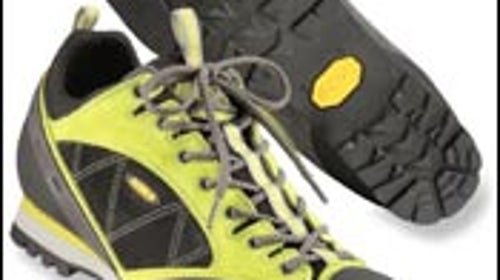
Asolo’s Distance cross-trainer
 Asolo Distance
I say that because I just dont like the idea of doing much real backpacking with trail-runners. Most shoes of that type have quite a bit of cushioning, which is fine when youre running, not so fine when supporting your body weight plus 30 to 40 pounds. And they dont have as much beef in the sole as hiking boots, so rocks and sticks are more apt to bruise and otherwise pound your foot. Without good support and protection, youre apt to find your feet are very sore and tired at the end of the day.
But, if you want to try it, just be sure to wear beefy trail-runners. Salomons Trail Pro SCS shoes ($100; www.salomonsports.com), Brooks Cascadia 2 Trail Runners ($95; www.brooksrunning.com), Asolos Distance cross-trainer ($115; www.asolo.com), and La Sportivas B5 Approach Shoes ($95; www.sportiva.com) all have lots of heft in this range. I especially like the Asolo shoes because they have a full rubber rand around the shoe perimeter, affording you some extra protection.
The votes are in: Check out the winners of Outside‘s 2006 Gear of the Year awards, including the year’s hottest trail runners.